Every spring in Denham Springs, I get the same question: mulch or pine straw? It’s the lawn care equivalent of asking a Cajun whether he prefers étouffée or gumbo. The honest answer is: it depends — and I’m about to break it down for you.
I’m Michael Dantone, The Landscape Mayor, and owner of Southern Buck Lawn. I’ve installed both mulch and pine straw on hundreds of properties across Walker, Denham Springs, and Baton Rouge. Here’s my completely honest, Louisiana-specific take on the great mulch vs. pine straw debate.
Black Mulch: The Showstopper
Black mulch is having a serious moment right now, and for good reason. Here’s why people love it:
- The contrast is stunning. Black mulch against green plants and a tan house creates a sharp, high-end look that makes every yard look expensive.
- It stays dark longer than brown or red mulch, especially if you use a quality dyed product.
- Excellent weed suppression — laid at 3 inches deep, black mulch blocks most weed germination.
- Moisture retention — helps your plants survive Louisiana’s hot, dry spells between our monsoon rains.
The downsides? It fades. Louisiana’s sun is ruthless. By fall, your black mulch may look more “charcoal gray.” And it can retain too much heat in summer, potentially stressing shallow-rooted plants if installed too thick.
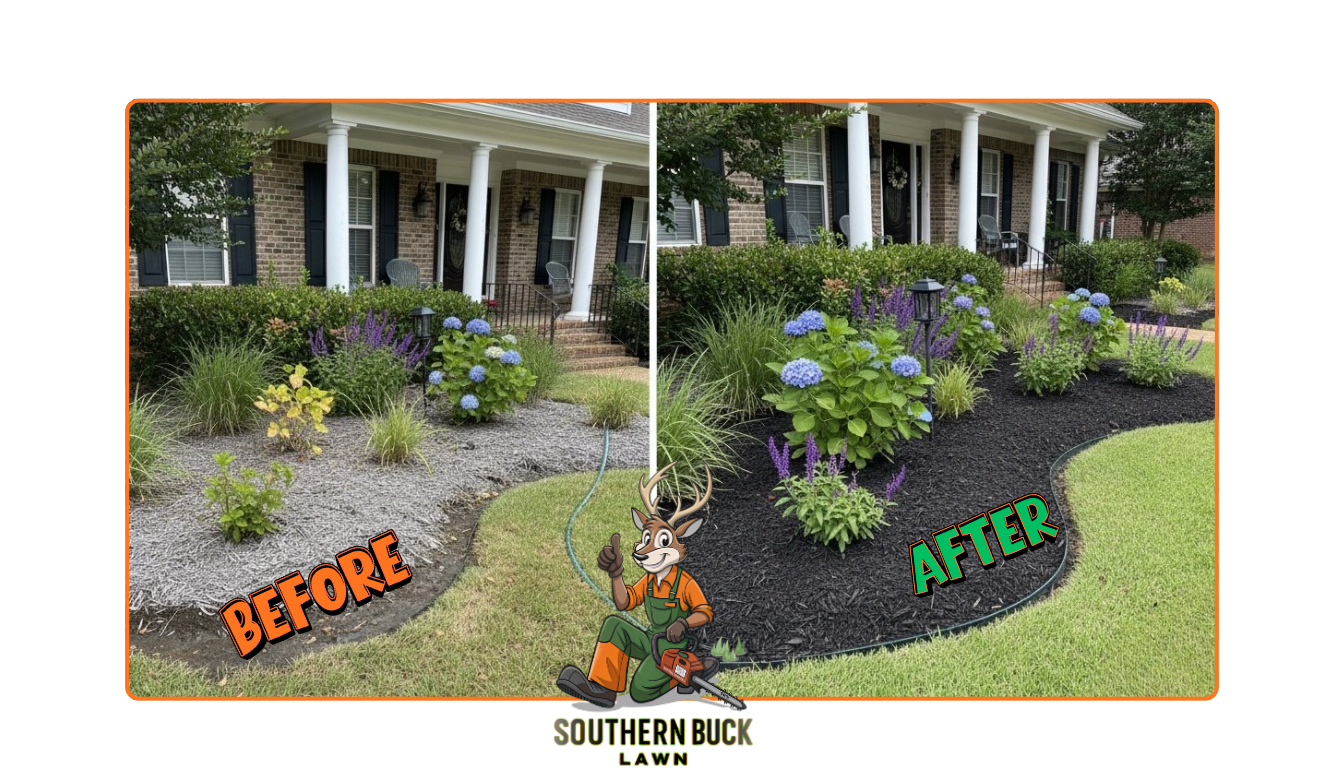
Before & After: Black Mulch Installation — Walker, LA (Southern Buck Lawn)
Red and Brown Mulch: The Classics
Brown and red mulch are classics for a reason:
- Red mulch pops beautifully with green plants and dark soil. It has a vibrant, almost “fresh landscaping” look that homeowners love.
- Brown/natural mulch blends naturally with Louisiana’s earth tones. It’s the most versatile choice for almost any home color.
- Both hold up slightly better in terms of heat stress on plants than black mulch, because they don’t absorb as much sunlight.
Pine Straw: Louisiana’s Secret Weapon
Pine straw is underrated by people who didn’t grow up in the South. Here’s the truth about pine straw:
- It’s the budget-friendly option — Pine straw typically costs less than mulch per square foot of coverage, and you can often get multiple installs per year for what one mulch install costs.
- It’s naturally acidic — This is huge for Louisiana. Many of our most popular landscape plants (azaleas, blueberries, gardenias) love acidic soil. Pine straw slowly acidifies as it breaks down, which is great for these plants.
- It breathes better than mulch — Pine straw doesn’t compact as tightly, which means better drainage and less waterlogged roots during our heavy Louisiana rains.
- Wildlife-friendly — Pine straw provides great habitat for beneficial insects and doesn’t harbor the mold issues that dense mulch can.
The downsides? Pine straw blows around in wind. After a heavy storm, you may find your pine straw has migrated across the yard. It also needs to be refreshed more frequently — usually twice a year in Louisiana versus once or twice for mulch.
Louisiana Climate Considerations
Here’s where it gets hyper-local. In Walker, Denham Springs, and the greater Baton Rouge area, we have specific conditions that affect this decision:
- High rainfall (60+ inches per year) — Both mulch and pine straw perform well, but mulch can develop white mold in especially wet spots. If your beds get puddles, pine straw may be the better drainage choice.
- Clay soil — Pine straw’s better drainage properties are a major win on Walker’s clay-heavy soils. Mulch over clay can create a soggy layer that invites root rot.
- Humidity and fungus — Dense, thick mulch in humid Louisiana summers can harbor fungal issues. Apply at the right depth (2-3 inches for mulch, 3-4 inches for pine straw) and don’t pack it against plant stems.
Cost Comparison: The Real Numbers
I’ll be upfront about the economics here. Pricing varies by season and market, but generally in Livingston Parish:
- Mulch — Higher upfront cost, but lasts 1-2 years before needing a refresh. Often a one-time seasonal install.
- Pine straw — Lower per-install cost, but needs refreshing 1-2 times per year to maintain that clean, full look.
Over a full year, the costs often balance out. It’s really about aesthetics and plant preference at that point.
What Michael Recommends
Here’s my personal recommendation, property by property:
- Curb appeal-focused homeowner — Black or red mulch, professionally installed. The visual impact is unmatched.
- Budget-conscious homeowner with large beds — Pine straw all the way. It’s cost-effective and it works beautifully.
- Acid-loving plant beds (azaleas, gardenias, blueberries) — Pine straw for its natural acidification.
- Clay soil with drainage issues — Pine straw for better water movement.
- High-visibility areas (front yard, entry beds) — Mulch. It looks pristine and professional.
Ready to Transform Your Beds?
Whether you go with black mulch or pine straw, the most important thing is professional installation. Improper depth, wrong placement, or mulch piled against plant stems can do real damage to your landscape.
See the results of our landscape design and installation services or check out our work on the projects page. We serve Walker, LA, Denham Springs, and the surrounding areas.
Call The Landscape Mayor at (225) 369-4434 or request a free estimate online.